Chapter XLVII. The Tragedy
Life of Joseph the Prophet, pp. 540 to 545
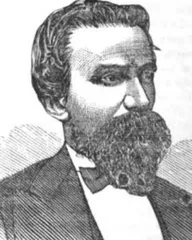
Last Words of the Prophet. Finale.
Carthage, June 27th, 1844.
A shower of musket balls were thrown up the stairway against the door of the prison in the second story, followed by many rapid footsteps.
While Generals Joseph and Hyrum Smith, Mr. Taylor and myself, who were in the front chamber, closed the door of our room against the entry at the head of the stairs, and placed ourselves against it, there being no lock on the door, and no catch that was unsealable.
The door is a common panel, and as soon as we heard the feet at the stairs head a ball was sent through the door, which passed between us, and showed that our enemies were desperadoes, and we must change our position.
General Joseph Smith, Mr. Taylor and myself sprang back to the front part of the room, and General Hyrum Smith retreated two-thirds across the chamber, directly in front of and facing the door.
A ball was sent through the door which hit Hyrum on the side of his nose, when he fell backwards, extended at length, without moving his feet.
From the holes in his vest (the day was warm, and no one had their coats on but myself), pantaloons, drawers and shirt, it appears evident that a ball must have been thrown from without through the window, which entered his back on the right side, and passing through, lodged against his watch, which was in his right vest pocket, completely pulverizing the crystal and face, tearing off the hands, and mashing the whole body of the watch. At the same instant the ball from the door entered his nose.
As he struck the floor he exclaimed emphatically, " I am a dead man." Joseph looked towards him and responded, " Oh, dear! Brother Hyrum," and opening the door two or three inches with his left hand, discharged one barrel of a six-shooter (pistol) at random in the entry, from whence a ball grazed Hyrum's breast, and entering his throat passed into his head, while other muskets were aimed at him and some balls hit him.
Joseph continued snapping his revolver around the casing of the door into the space as before, three barrels of which missed fire, while Mr. Taylor with a walking stick stood by his side and knocked down the bayonets and muskets which were constantly discharging through the doorway, while I stood by him, ready to lend any assistance, with another stick, but could not come within strikingdistance without going directly before the muzzle of the guns.
When the revolver failed we had no more firearms, and expected an immediate rush of the. mob, and the doorway full of muskets, half way in the room, and no hope but instant death from within.
Mr. Taylor rushed into the window, which is some fifteen or twenty feet from the ground. When
his body was nearly on a balance a ball from the door within entered his leg, and a ball from without struck his watch, a patent lever, in his vest pocket near the left breast, and smashed it into "pi," leaving the hands standing at 5 o'clock, 16 minutes and 26 seconds, the force of which ball threw him back on the floor, and he rolled under the bed which stood by his side, where he lay motionless, the mob from the door continuing to fire upon him, cutting away a piece of flesh from his left hip as large as a man's hand, and were hindered only by my knocking down their muzzles with a stick, while they continued to reach their guns into the room, probably left handed, and aimed their discharge so far round as almost to reach us in the corner of the room to where we retreated and dodged, and then I recommenced the attack with my stick.
Joseph attempted, as the last resort, to leap the same window from whence Mr. Taylor fell, when two balls pierced him from the door and one entered his right breast from without, and he fell outward, exclaiming, " O, Lord, my God ! " As his feet went out of the window my head went in, the balls whistling all around. He fell on his left side, a dead man.
At this instant the cry was raised, " He's leaped the window," and the mob on the stairs and in the entry ran out.
I withdrew from the window, thinking it of no use to leap out on a hundred bayonets then around General Smith's body.
Not satisfied with this, I again reached my head out of the window and watched some seconds to see if there were any signs of life, regardless of my own, determined to see the end of him I loved. Being fully satisfied that he was dead, with a hundred men near the body, and more coming round the corner of the jail, and expecting a return to our room, I
rushed towards the prison door at the head of the stairs, and through the entry from whence the firing had proceeded, to learn if the doors into the prison were open.
When near the entry Mr. Taylor cried out, ' take me.' I pressed my way until I found all doors unbarred, returning instantly, caught Mr. Taylor under my arm, and rushed by the stairs into the dungeon, or inner prison, stretched him on the floor, and covered him with a bed in such a manner as not likely to be perceived, expecting an immediate return of the mob.
I said to Mr. Taylor, " This is a hard case to lay you on the floor, but if your wounds are not fatal I want you to live to tell the story." I expected to be shot the next moment, and stood before the door awaiting the onset. Willard Richards.
From the point where Joseph leaped the window, the record continues :
" He fell partly on his right shoulder and back, his neck and head reaching the ground a little before his feet, and he rolled instantly on his face.
" From this position he was taken by a man who was barefoot and bareheaded, and having on no coat, his pants rolled up above his knees, and his shirt sleeves above his elbows. He set Joseph against the south side of the wellcurb, which was situated a few feet from the jail, when Col. Levi Williams ordered four men to shoot him. They stood about eight feet from the curb, and fired simultaneously. A slight cringe of the body was all the indication of pain visible when the balls struck him, and he fell on his face.
" The ruffian who set him against the well-curb
now gathered a bowie-knife for the purpose of severing his head from his body. He raised the knife, and was in the attitude of striking when a light, so sudden and powerful, burst from the heavens upon the bloody scene (passing its vivid chain between Joseph and his murderers), that they were struck with terror. This light, in its appearance and potency, baffles all powers of description. The arm of the ruffian that held the knife fell powerless, the muskets of the four who fired fell to the ground, and they all stood like marble statues, not having the power to move a single limb of their bodies.
" The retreat of the mob was as hurried and disorderly as it possibly could have been. Colonel Williams hallooed to some who had just commenced their retreat to come back and help to carry off the four men who fired, and who were still paralyzed. They came and carried them away by main strength to the baggage wagons, when they fled towards Warsaw."
Upon the tide of grief that swept over Nauvoo, and the consternation that filled the hearts of the mob, when the awful deed became known, we will not dwell. Neither will we attempt to depict that scene of woe which occurred when the bodies of the slain were delivered into the hands of their families.
A whole people had been cruelly, fiendishly betrayed and bereaved. Awful, beyond the power of words to picture, was the lament.
To-day some of that very mob remain in peace near the scene of that atrocious crime, unwhipped of justice, and not one of that horde of assassins has ever felt the lash of the law.
Thus lived, and labored, and loved, and died the martyr prophet of the nineteenth century. Thus flashed athwart the black midnight of his age the light of the latter-days. But the darkness comprehended it not ; and even as one of old was he betrayed and sacrificed.
Back to that scene on Calvary leaps the thought of man. Instinctively are associated the tragedy of that day and the tragedy of this. Across the ages stride the footsteps of the self-same genius In the agony of death appears the self-same spirit. Nay, from out the agony of Calvary and of Carthage comes the self-same voice : " Lama Sabacthana ! "— " Oh, Lord, my God ! "
America, thou land of promise !
O, Jerusalem, Jerusalem !