Chapter X. An Historical Digression
Life of Joseph the Prophet, pp. 94 to 108
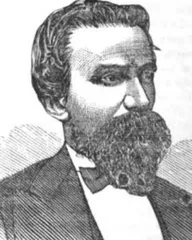
Parley P. Pratt, Sidney Rigdon and Orson Pratt. Brief Sketch of the Pratts Their Early and Important Services to the Church. Parley's Narrative. His Description of Joseph. Resumption of Joseph's Narrative. The St. Paul of Mormondom.
SERVICES TO THE CHURCH PARLEY'S NARRA- TIVE— HIS DESCRIPTION OF JOSEPH RESUMP- TION of Joseph's narrative — the st. paul
OF MORMONDOM.
For a rounded comprehension of the rise of the latter-day work, we must here diverge from the direct historic track of the Church, under Joseph, to trace a kindred and preparatory religious movement in Ohio, connected with the history and ministry of Parley P. Pratt and Sidney Rigdon, prior to their greater career as Mormon Apostles.
Parley P. Pratt, who was the first of these religious chieftains to embrace Mormonism, was a man born to an apostolic mission. He was endowed with the nature and gifts of a prophet. This of itself explains much of his early career, and suggests the providential fitness of the man to the greater apostleship of his after life.
As much of the integrity of Mormonism rests with the Pratts (Parley and Orson), it may be well to make brief mention of their origin, to show how
naturally they fell into their places as two of the chief apostles of the latter days. Not always, it must be confessed, do we find the sons of the prophets among the prophets, but when they are thus found there seems in the circumstance a certain predestined fitness of the instrument to the divine purpose.
The brothers Parley and Orson Pratt are descendants of Lieut. William and Elizabeth Pratt, who, with a brother John Pratt, were among the "Pilgrim Fathers." They came from Essex Co., England, about the year 1633, and were found among the first settlers of Hartford, Conn., in the year 1639. (They are supposed to have accompanied the Rev. Thomas Hooker and his congregation from Newtown, — now Cambridge, — Mass., through a dense wilderness, inhabited only by savages and wild beasts, and became the founders of the colony of Hartford, Conn., in June, 1636, and thence to Saybrook about the year 1645).
The Mormon career of the brothers Parley and Orson answers well to this record of their Pilgrim ancestors. At the age of nineteen Parley migrated from the State of New York to Ohio. Taking leave of his friends at the old homestead, he started westward in October, 1826. He paid out most of his money in Rochester, N. Y., for a small pocket Bible, and continued his journey as far as Buffalo, N. Y., where he engaged to work his passage to Detroit. He traveled until he came to a small settlement about thirty miles west of Cleveland. There he cleared a farm from forest land, and the following year returned for a season to the old home in New
York; thence returning to his farm in Ohio, with a young wife, with whom he purposed to there establish a permanent home.
Eighteen months were passed by the pious young couple in their wilderness settlement, when the Rev. Sidney Rigdon, a religious reformer of those times, came into the neighborhood. His preaching so attracted young Parley that he united with him as a sort of apostolic compeer. Under Mr. Rigdon the new disciples organized a society.
"At the commencement of 1830," says Parley, " I felt drawn out in an extraordinary manner to search the prophets, and to pray for an understanding of the same. My prayers were soon answered, even beyond my expectations ; the prophecies of the holy prophets were opened to my view; I began to understand the things which were coming on the earth — the restoration of Israel, the coming of the Messiah, and the glory that should follow. I was so astonished at the darkness of myself and mankind on these subjects that I could exclaim with the prophet, surely, ' Darkness covers the earth, and gross darkness the people.' "
Impelled by the spirit, he soon resolved on a ministerial mission, on which he started, with his wife, in August, 1830, forsaking their home for the gospel's sake. Here is the sequel, in his own words:
"Arriving at Rochester, I informed my wife that, notwithstanding our passage being paid through the whole distance, I must leave the boat, and her to pursue her passage to our friends, while I would stop awhile in this region. Why, I did not know; but so it was plainly manifested by the spirit to me.
* * * I took leave of her and the boat early in the morning, just at the dawn of day, and walked ten miles into the country, where I stopped to breakfast with a Mr. Wells. I proposed to preach in the evening. Mr. Wells readily accompanied me through the neighborhood to circulate the appointment. We visited an old Baptist deacon by the name of Hamlin. After hearing of our appointment, he began to tell of a very strange book in his possession, which had just been published. * * * He promised me the perusal of it. Next morning I called at his house, where, for the first time, my eyes beheld the Book of Mormon. * * * As I read, the spirit of the Lord was upon me, and I knew and comprehended that the book was true.
* * * I soon determined to see the young man who had been the instrument of its discovery and translation. I accordingly visited the village of Palmyra, and enquired for the residence of Mr. Joseph Smith. I found it some two or three miles from the village."
Approaching the house he overtook a gentleman, who turned out to be Hyrum Smith, and was informed by him that Joseph was then in Pennsylvania. Hyrum, however, welcomed him into the house, and they spent the night together, conversing upon the book and kindred topics. In the morning he was presented with a copy of the Book of Mormon, and then hastened on to fill an appointment for the evening, thirty miles away.
After a short ministerial tour Parley returned to Hyrum Smith's residence, and demanded baptism at his hands. He continues :
" I tarried with him one night, and the next day we walked some twenty-five miles to the residence of Mr. Whitmer, in Seneca Co. Here we arrived in the evening, and found a most welcome reception. * * * The next day I was baptized by Oliver Cowdery, in Seneca Lake. A meeting was held the same evening, and after singing and prayer Elder Cowdery and others proceeded to lay their hands upon my head in the name of Jesus, for the gift of the Holy Ghost. After which I was ordained to the office of an elder in the Church, which included authority to preach, baptize, administer the sacrament, administer the Holy Spirit, by the laying on of hands in the name of Jesus Christ, and to take the lead of meetings of worship."
He now commenced his ministry in earnest, as a Mormon elder, and soon thereafter baptized his brother Orson. Again visiting the birthplace of Mormonism, he says:
"On our arrival, we found that brother Joseph Smith had returned to his father's residence in Manchester, near Palmyra, and here I had the pleasure of seeing him for the first time."
Here may properly be given Parley's description of Joseph, which, as it seems to have been written to portray him at that time, will be read with interest:
" President Joseph Smith was in person tall and well built, strong and active ; of a light complexion, light hair, blue eyes, very little beard, and of an expression peculiar to himself, on which the eye naturally rested with interest, and was never weary of beholding. His countenance was ever mild,
affable, beaming with intelligence and benevolence; mingled with a look of interest and an unconscious smile, or cheerfulness, and entirely free from all restraint or affectation of gravity; and there was something connected with the serene and steady penetrating glance of his eye, as if he would penetrate the deepest abyss of the human heart, gaze into eternity, penetrate the heavens, and comprehend all worlds.
" He possessed a noble boldness and independence of character; his manner was easy and familiar; his rebuke terrible as the lion; his benevolence unbounded as the ocean ; his intelligence, universal, and his language abounding in original elpquence peculiar to himself — not polished-— not studied j-rnqt smoothed and softened by education a,nd refined by art; but flowing forth in its own /native •■simplicity; and profusely abounding in variety of subject and manner. He interested and edified, while, at the same time, he amused and entertained his audience; and none listened to him that were ever weary with his discourse. I have even known him to retain a congregation of willing and anxious listeners for many hours together, in the midst of cold or sunshine, rain or wind, while they were laughing at one moment and weeping the next. Even his most bitter enemies were generally overcome, if he could once get their ears."
This brings up the connection with Joseph's own narrative in the preceding chapter, as it is seen that just after the first conference of the church, therein noted, a revelation is given to Parley P. Pratt and Ziba Peterson, sending them westward on a mission
to the " Lamanites." [The Indians]. Here is the historic link as supplied by Parley:
"It was now October, 1830. A revelation had been given through the mouth of this Prophet, seer, and translator, in which elders Oliver Cowdery, Peter Whitmer, Ziba Peterson and myself were appointed to go into the wilderness, through the western States, and to the Indian Territory. Making arrangements for my wife in the family of the Whitmer's, we took leave of our friends and the church late in October, and started on foot.
" After traveling for some days we called on an Indian nation at or near Buffalo, and spent part of the.day. with them, instructing them in the knowledge of, the.' record of their forefathers. We were kindly received) and much interest was manifested •by them on. heading this news. We made a present of two copies of the Book of Mormon to certain of them who could read, and repaired to Buffalo. Thence we continued our journey, for about two hundred miles, and at length called on Mr. Rigdon, my former friend and instructor, in the Reformed Baptist society. He received us cordially and entertained us with hospitality.
" We soon presented him with a Book of Mormon, and related to him the history of the same. He was much interested, and promised a thorough perusal of the book. We tarried in this region for some time, and devoted our time to the ministry and visiting from house to house.
"At length Mr. Rigdon and many others became convinced that they had no authority to minister in the ordinances of God, and that they had not been
legally baptized and ordained. They, therefore, came forward and were baptized by us, and received the gift of the Holy Ghost by the laying on of hands, and prayer in the name of Jesus Christ.
" The news of our coming was soon noised abroad, and the news of the discovery of the Book of Mormon, and the marvelous events connected with it. The interest and excitement now became general in Kirtland, and in all the region round about. The people thronged us night and day, insomuch that we had no time for rest or retirement. Meetings were convened in different neighborhoods, and multitudes came together soliciting our attendance, while thousands flocked about us daily ; some to be taught, some for curiosity, some to obey the gospel, and some to dispute or resist it.
"In two or three weeks from our arrival in the neighborhood with the news, we had baptized one hundred and twenty-seven souls-,-and this number soon increased to one thousand. The disciples were filled with joy and gladness, while rage and lying was abundantly manifested by gainsayers; faith was strong, joy was great, and persecution heavy.
" We proceeded to ordain Sidney Rigdon, Isaac Morley, John Murdock, Lyman Wight, Edward Partridge and many others to the ministry ; and, leaving them to take care of the churches and to minister the gospel, we took leave of the saints and continued our journey."
The Prophet himself has sketched the history of Sidney Rigdon up to this point, which establishes the character of his mission as that of a John the
Baptist to the Latter-day Work. The following is a digest of the same :
Sidney S. Rigdon was born in St. Clair township, Alleghany Co., Pa., on the 19th of Feb. 1793. In his twenty-fifth year he connected himself with a society, which in that country was called Regular Baptists. In March, 1819, he received a license to preach in that society, and in the following May he left Pennsylvania and went to Trumbull Co., Ohio, where he was subsequently married. In 1821 he was called to the pastoral charge of the First Baptist church of Pittsburg, which invitation he accepted early in the following year, and soon became an effective and popular minister. After laboring in that capacity for two and a half years, he withdrew from the society, because of a settled conviction that the doctrines maintained by it were not altogether in accordance with the Scriptures. From the same society shortly afterward separated Alexander Campbell, who subsequently became distinguished as the founder of the " Campbellites," or " Disciples;" but it is proper to here state that Mr. Rigdon was his earnest coadjutor in the inception of that work, and, quite as much as Mr. Campbell, was its founder. Having now retired from the ministry, Mr. Rigdon engaged as a day laborer in a tannery, which employment he followed for two years, after which he removed to Barnbridge, Geauga Co., Ohio, where the people solicited him to preach. He complied with their request, and' from that time forward devoted himself to the ministry, confining himself, however, to no creed, but holding up the Bible as the rule of faith, and advocating
the doctrines of repentance and baptism for the remission of sins. The doctrines which he advanced being new, public attention was awakened, and great excitement prevailed throughout that whole section of country, and frequently the congregations which he addressed were so large that it was impossible to make himself heard by all. His fame as an orator and deep reasoner in the Scriptures spread far and wide, and he soon gained a popularity and an elevation which has fallen to the lot of but few. Soon numbers felt the importance of obeying that form of doctrine which had been delivered to them. He accordingly commenced to baptize, and like John of old, there flocked to him people from all the region round about, to be baptized of him. Nor was this desire confined to individuals or families, but whole societies threw away their creeds and articles of faith, and became obedient to the faith he promulgated, and he soon had large and flourishing societies throughout that whole region of country. It is proper to note that in the meantime he had become a resident of the town of Mentor, some thirty miles distant from Bainbridge, in the same county. In the Fall of 1830, elders Parley P. Pratt, Ziba Peterson, Oliver Cowdery and Peter Whitmer called at that town, on their way to Missouri, testifying to the truth of the Book of Mormon, and that the Lord had raised up a prophet, and restored the priesthood. The first house at which they called was elder Rio-don's. He was at first quite incredulous about the Book of Mormon, which until then he had never heard of nor seen, but expressed a willingness to read and investigate.
After considering the Book for two weeks, praying to the Lord for direction, he was fully convinced of the truth of the work by a revelation from Jesus Christ, which was made known to him in a remarkable manner, so that he could exclaim, " flesh and blood hath not revealed it unto me, but my father which is in heaven."
The above brief history has an extraordinary relation to the rise and progress of the Church of Latter-day Saints. The Church which Joseph, under God, founded absorbed the churches which Sidney founded, and Kirtland soon became the Zion where the Prophet lifted his standard for the gathering- of the Saints.
Immediately after his baptism, Sidney Rigdon, accompanied by Edward Partridge, paid a visit to the Prophet, "to enquire of the Lord." The following is the "word" received, and is itself a page of quite suggestive history :
Listen to the voice of the Lord your God, even Alpha and Omega, the beginning and the end, whose course is one eternal round, the same to-day as yesterday, and for ever. I am Jesus Christ, the Son of God, who was crucified for the sins of the world, even as many as will believe on my name, that they may become the sons of God, even one in me as I am in the Father, as the Father is one in me, that we may be one.
Behold, verily, verily, I say unto my servant Sidney, 1 have looked upon thee and thy works. I have heard thy prayers, and prepared thee for a greater work. Thou art blessed, for thou shalt do great things. Behold thou wast sent forth, even as John, to prepare the way before me, and before
Elijah which should come, and thou knewest it not. Thou didst baptize by water unto repentance, but they received not the Holy Ghost; but now I give unto thee a commandment, that thou shalt baptize by water, and they shall receive the Holy Ghost by the laying on of the hands, even as the apostles of old.
And it shall come to pass that there shall be a great work in the land, even among the Gentiles, for their folly and their abominations shall be made manifest in the eyes of all people ; for I am God, and mine arm is not shortened ; and I will show miracles, signs, and wonders, unto all those who believe on my name. And whoso shall ask it in my name in faith, they shall cast out devils; they shall heal the sick; they shall cause the blind to receive their sight, and the deaf to hear, and the dumb to speak, and the lame to walk; and the time speedily cometh that great things are to be shown forth unto the children of men ; but without faith shall not anything be shown forth except desolations upon Babylon, the same which has made all nations drink of the wine of the wrath of her fornication. And there are none that doeth good, except those who are ready to receive the fullness of my gospel which I have sent forth unto this generation.
Wherefore, I have called upon the weak things of the world, those who are unlearned and despised, to thresh the nations by the power of my Spirit : and their arm shall be my arm, and I will be their shield and their buckler; and I will gird up their loins, and they shall fight manfully for me; and their enemies shall be under their feet; and I will let fall the sword in their behalf, and by the fire of mine indignation will I preserve them. And the poor and the meek shall have the gospel preached unto them, and they shall be looking forth for the time of my coming, for it is nigh at hand: and they shall learn the parable
of the fig-tree, for even now already summer is nigh, and I have sent forth the fullness of my gospel by the hand of my servant Joseph; and in weakness have I blessed him, and I have given unto him the keys of the mystery of those things which have been sealed, even things which were from the foundation of the world, and the things which shall come from this time until the time of my coming, if he abide in me, and if not, another will I plant in his stead.
Wherefore, watch over him that his faith fail not, and it shall he given by the Comforter, the Holy Ghost, that knoweth all things : and a commandment I give unto thee, that thou shalt write for him; and the scriptures shall be given, even as they are in mine own bosom, to the salvation of mine own elect ; for they will hear my voice, and shall see me, and shall not be asleep, and shall abide the day of my coming, for they shall be purified, even as I am pure. And now I say unto you, tarry with him, and he shall journey with you ; forsake him not, and surely these things shall be fulfilled. And inasmuch as ye do not write, behold, it shall be given unto him to prophesy: and thou shalt preach my gospel and call on the holy prophets to prove his words, as they shall be given him.
Keep all the commandments and covenants by which ye are bound; and I will cause the heavens to shake for your good, and Satan shall tremble and Zion shall rejoice upon the hills and flourish, and Israel shall be saved in mine own due time. And by the keys which I have given shall they be led, and no more be confounded at all. Lift up your hearts and be glad, your redemption draweth nigh. Fear not, little flock, the kingdom is yours until I come. Behold I come quickly. Even so. Amen.
And just previously another had come, whose
subsequent evangelical career has entitled him to a volume in the " Acts of the Modern Apostles." Joseph says :
"In the forepart of November [1830], Orson Pratt, a young man of 19 years, who had been baptized at the first preaching of his brother Parley P. Pratt, Sept. 19th (his birthday), about six weeks previously, in Canaan, N. Y., came to enquire of the Lord what his duty was, and received the following answer :
My son Orson, hearken and hear and behold what I, the Lord God, shall say unto you, even Jesus Christ your Redeemer, the light and the life of the world; a light which shineth in darkness and the darkness comprehendeth it not ; who so loved the world that he gave his own life, that as many as would believe miarit become the sons of God : wherefore you are my son, and blessed are you because you have believed ; and more blessed are you because you are called of me to preach my gospel, to lift up your voice as with the sound ol a trump, both long and loud, and cry repentance unto a crooked and perverse generation, preparing the way of the Lord for his second coming ; for behold, verily, verily, I say unto you, the time is soon at hand, that I shall come in a cloud with power and great glory, and it shall be a great day at the time of my coming, for all nations shall tremble.
But before that great day shall come, the sun shall be darkened, and the moon be turned into blood, and the stars shall refuse their shining, and some shall fall, and great destructions await the wicked: wherefore lift up your voice and spare not, for the Lord God hath spoken. Therefore prophesy, and it shall be given by the power of the Holy Ghost; and if you are faithful, behold, I am with
you until I come: and verily, verily, I say unto you, I come quickly. I am your Lord and your Redeemer. Even so. Amen.
Not more important was the coming of Sidney ( Rigdon than that of Parley and Orson Pratt. Undoubtedly the splendor of Sidney's career gave to the Mormon Church a substantial dignity,0 but V\ Parley and Orson Pratt became in some respects the two most potent apostles of the dispensation. Their converts, since that time, have been thousands. In fact it is not too much to say that, by their preaching and writings, directly and indirectly, i tens of thousands have been brought into the faith. 'I *■ Parley's " Voice of Warning" was almost as a New Testament to the Church. His inspired views and nervous epigramic style fascinated all who read his book. His Hebraic pen made the ancient prophets live again in the divine action of our own times ; while his learned brother Orson has been as the veritable St. Paul of the Latter Days.
But Joseph was still the prophet of the dispensation. It was he who gave the epic subject, — so vast that his ablest apostles were well nigh lost in its mighty sweep; it was he who furnished the marvelous themes upon which they wrought, each his finest work; it was he who inspired the whole with an archangel's genius.