The Church of Jesus Christ of Latter-day Saints at the Parliament of Religions
Improvement Era, vol. 2, no. 8, June 1899, pp. 584 to 589
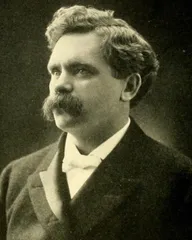
THE CHURCH OF JESUS CHRIST OF LAT- TER-DAY SAINTS AT THE PARLIA- MENT OF RELIGIONS. BY B. H. ROBERTS.
I.
THE ORIGIN OF THE PARLIAMENT.
The idea of a series of congresses for the consideration of the greatest themes in which mankind is interested, to be held in
connection with the World's Columbian Exposition at Chicago, in 1893, originated with Charles Carroll Bonney, in the summer of 1889. In the early days of autumn he presented his views upon the subject to a few friends, among whom was the editor of the Statesman's Magazine, Walter Thomas Mills. This gentleman was so impressed with the greatness of the thought that he prevailed upon Mr. Bonney to write an article for the Statesman's Magazine, setting forth his ideas upon the series of congresses proposed. In the course of that article Mr. Bonney said:
The coining glory^lof the World's Fair of 1893, should not be the exhibit then to be made of the material triumphs, industrial achievements, and mechanical victories of man, however magnificent that display may be. Something higher and nobler is demanded by the progressive spirit of the present age. In connection with that important event of the world, all government jurisprudence, finance, science literature, education and religion should be represented in a congress of statesmen, jurists, financiers, scientists, literati, teachers, and theologians greater in numbers, more
THE CHURCH AT THE PARLIAMENT OF RELIGIONS. 585
widely representative of all peoples and nations and tongues than any assemblage which has ever yet been convened."
This may be said to be the heart of Mr. Bonney's proposition; and hence there was adopted as a motto of all the congresses,
"Not things, but men. Not matter but mind."
The proposition in the Statesman's Magazine attracted widespread attention, and at last the matter took definite form by the government making an appropriation to meet the expenses connected with such an elaborate undertaking. The State Department sent to foreign governments an official announcement concerning the purpose of the congress, in the course of which it was stated:
"Among the great themes which the congresses are expected to consider are the following: the grounds of fraternal union in the language, literature, domestic life, science, art, and civil institutions of different peoples; the economic, industrial and financial problems of tbe age; educational systems, their advantages and their defects, and the means by which they may best be adapted to Hhe recent enormous increase in all departments of knowledge; the practicability of a common language for use in the commercial relations in the civilized world; international copyright and the laws of intellectual property and commerce; immigration and naturalization laws and the proper international privileges of alien governments and their subjects or citizens; the most efficient and advisable means of preventing or decreasing pauperism, insanity and crime, and of increasing productive ability, prosperity and virtue throughout the world; international law as a bond of union and means of mutual protection, and how it may best be enlarged, perfected and authoritatively expressed; the establishment of the principles of judicial justice as the supreme law of international relations and the general substitution of arbitration for war in the settlement of international controversies."
This of course refers to the whole series of congresses held during that memorable summer of 1893; but as the series of articles under the title at the head of this writing has to do only with the Parliament of Religions, we shall from this point confine our remarks to that subject. And indeed the Parliament of Religions was the principal feature, and, quite generally regarded as the
586 IMPROVEMENT ERA.
crowning glory, of the whole series of congresses. It was also the
chief pride of Mr. Bonney, since of it he said:
"When it pleased God to give me the idea of the world's congresses of 1893, there came with that idea a profound conviction that their crowning glory should be a fraternal conference of the world's religions."
Toward the close of 1889 the general committee on religious congresses, was appointed by President Charles C. Bonney. Rev. John Henry Barrows, D.D., pastor of the First Presbyterian Church of Chicago, was made chairman of the committee, and his associates were the following eminent gentlemen, prominent in religious thought and work:
The Rev. L, P. Mercer, pastor of the New Church (Swedenborgian); Mr. J. W. Plummer, an active member of the Society of Friends; Rev. J. Berger, of the German Methodist Church; Rev. John Z. Torgersen, of the Norwegian Lutheran Church, and Rev. M. Ranseen, of the Swedish Lutheran Church; Rt. Rev. Charles Edward Cheney, D.D., one of the founders and prominent leaders of the Reformed Episcopal Church; Rev. Jenkin Lloyd-Jones, a well-known writer and active worker among the advanced Unitarians; Rev. Dr. A. J. Canfield, the eloquent pastor of St. Paul's Universalist Church, Chicago; Dr. E. G. Hirsch, minister of Sinai Temple and the learned professor of rabbinic literature in the University of Chicago; Rev. Dr. Frank M. Bristol, the most eloquent Methodist of the northwest; Rev. William M. Lawrence, D.D., pastor of the Second Baptist Church of Chicago, a far-famed successful preacher; Rev. Dr. F. A. Noble, of Union Park Congregational Church, one of the prominent leaders of his denomination; Rt. Rev. William E. McLaren, D.D., D.C.L., Protestant Episcopal Bishop of Chicago and active in promoting the Parliament; The Most Rev. P. A. Feehan, archbishop of the Catholic Church, and the Rev. David Swing, pastor of the Central Church of Chicago.
The committee opened a correspondence with the leading religionists in many lands, and early in June, 1891, sent out to the world a preliminary address, in the course of which, concerning the objects to be achieved by the assembling of this great parliament, it was stated:
"Believing that God is, and that he has not left himself without witness; believing that the influence of religion tends to advance the general welfare, and is the most vital force in the social order of every people.
THE CHURCH AT THE PARLIAMENT OF RELIGIONS. 587
and convinced that of a truth God is no respector of persons, but that in every nation he that feareth him and worketh righteousness is accepted of him, we affectionately invite the representatives of all faiths to aid us in presenting to the world, at the exposition of 1893, the religious harmonies and unities of humanity, and also in showing forth the moral and spiritual agencies which are at the root of human progress. It is pro-
posed to consider the foundations of religious faith, to review the triumphs of religion in all ages, to set forth the present state of religion among the nations and its influence over literature, art, commerce, government and the family life, to indicate its power in promoting temperance and social purity and its harmony with true science, to show its dominance in the higher institutions of learning, to make prominent the value of the weekly rest-day on religious and other grounds, and to contribute to those forces which shall bring about the unity of the race in the worship of God and the service of man.
A favorable response in the main was made to the invitations to participate in this proposed parliament; and indeed, some of the replies contained a mass of fulsome praise for the undertaking, and most extravagant notions were entertined as to the results which would grow out of such a gathering. The high esteem, however, in which the project was held was not universal, for there was some very pronounced opposition to it; and some of it from very high authority in Christendom. A good many of the religious journals in America came out in condemnation of the proposed Parliament. The general assembly of the Presbyterian Church in the United States of America, at its meeting in Portland, in 1892, passed resolutions emphatically disapproving of the Parliament. His grace, the Archbishop of Canterbury, not only refused to participate in the meetings of the Parliament himself, but made such an answer to the address of the committee, that it may be said to have almost effectively checked all the enthusiasm that the Episcopal Church in America and England might otherwise have had in the enterprise; and as the Archbishop's objections may be said to summarize all objections urged against the undertaking, I quote his letter to the chairman of the Parliament in ex tenso:
I am afraid that I cannot write the letter which, in yours of March 20th, you wish me to write, expressing a sense of the importance of the proposed conference, without its appearing to be an approval of the scheme. The difficulties which I myself feel are not questions of dis-
—
588 IMPROVEMENT ERA.
tance and convenience, but rest on the fact that the Christian religion is the one religion. I do not understand how that religion can be regarded
as a member of a Parliament of religions without assuming the equality of the other intended members and the parity of their position and claims* Then again, your general program assumes that the Church of Rome is the Catholic Church, and treats the Protestant Episcopal Church of America as outside the Catholic Church, I presume that the Church of England would be similarly classified: and that view of our position is untenable. Beyond this, while I quite understand how the Christian religion might produce its evidence before any assembly, a "presentation" of that religion must go far beyond the question of evidences, and must subject to public discussion that faith and devotion which are its characteristics, and which belong to a region too sacred for such treatment. I hope this
explanation will excuse me with you for not complying with your request."
It will be seen that the grounds of the refusal to co-operate in the Parliament are: First —That to take part in the proposed Parliament, the Christian religion must be placed upon an equality with other religions, a position, in the archbishop's view, that was altogether incompatible for Christianity, which is the one religion. Second —Christianity is too sacred for such a treatment as it would likely receive in the Parliament. Third —That the Church of Rome is recognized in name as the Catholic Church, and "treats the Protestant Episcopal Church of America," [and it may be said technically this distinction places all Protestant churches in the same position] as outside the Catholic Church. Another Christian minister of less exalted station, however, Rev. E. J. Eitel, of Hong Kong, China —was very pronounced, in his opposition, saying:
"Let me warn you not to deny the sovereignty of your Lord by any further continuance of your agitation in favor of a Parliament not sanctioned by his word. If misled yourself, at least do not mislead others, nor jeopardize, I pray you, the precious life of your soul by playing fast and loose with the truth, and coquetting with false religions. I give you credit for the best intentions, but let me warn you that you are unconsciously planning treason against Christ."
The Sultan of Turkey was also decidely opposed to the Parlia-
THE CHURCH Al THE PARLIAMENT OF RELIGIONS. 589
ment, and it is said that his opposition became very embarrassing to the leaders of the Greek and Armenian churches in the Turkish empire. There were, however, prominent representatives of both those churches present at the Parliament, and the part they took in the meetings thereof was both considerable and interesting. The object of the parliament was more specifically set out by the committee in the following official statement of its progress:
To bring together in conference, for the first time In history,
the leading representatives of the great historic religions of the world. 2. To show to men, in the most impressive way, what and how many important truths the various religions hold and teach in common. 3. To promote and deepen the spirit of human brotherhood among religious men of diverse faiths, through friendly conference and mutual good understanding, while not seeking to foster the temper of indifferentism, and not striving to achieve any formal and outward unity. 4. To set forth, by those most competent to speak, what are deemed to be the important distinctive truths held and taught by each religion and by the various chief branches of Christendom. 5. To indicate the impregnable foundations of theism, and the reasons
for man's faith in immortality, and thus to unite and strengthen the forces which are adverse to a materialistic philosophy of the universe. 6. To securefrom leading scholars, representing the Brahman, Buddhist, Confucian, Parsee, Mohammedan, Jewish and other faiths, and from representatives of the various churches of Christendom, full and accurate statements of the spiritual and other effects of the religions which they hold upon the literature, art, commerce, government, domestic and social life of the people among whom these faiths have prevailed. 7. To enquire what light each religion has afforded, or may afford, to other religions of the world. 8. To set forth, for permanent record to be published to the world, an accurate and authoritative account of the present condition and outlook of religion among the leading nations of the earth. 9. To discover, from competent men, what light religion has to throw on the general problems of the present age, especially the important questions connected with temperance, labor, education, wealth and poverty. 10. To bring the nations of the earth into a more friendly fellowship in the hope of securing permanent international peace.
This, briefly told, the orign of the Parliament: these, also, the purposes which it desired to achieve.