Brigadier-General Richard W. Young
Improvement Era, vol. 23, no. 4, February 1920, pp. 321 to 326
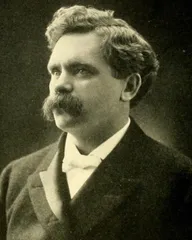
Brigadier-General Richard W. Young An Appreciation By B. H. Roberts, Chaplain of the 145th F. A.
"His life was gentle, and the elements So mix'd in him that nature might stand up And say to all the world, This is a man!" I cannot remember when I first heard of Richard W. Young, nor when I first met him. There is a faint recollection of hearing about him in connection with his graduation from West Point, and his being the grandson of the late President Brigham Young, but nothing is positive or distinct. It all rests in that twilight zone of "first remembrances," many of which, I half suspect, are made up of what one subsequently hears or learns about a subject or person, or incident, and then unconsciously mortises that later gained information into what are his "earliest recollections." Such are the mental tricks we mortals sometimes play upon ourselves. In this case, however, I think the probabilities are that I really had some true recollection of his graduation, for the reason that a boyhood friend of mine had been scheduled, by his family, for a course at the national military academy at West Point, and we used to discuss this projected prospect of my friend, and this in connection with what I regard as my earliest recollection of General Young. If this recollection is true then I have known of General Young since 1882, the year of his graduation. My first really distinct contact and association with the General was during the first political campaign under statehood, the 1896, when he ran upon the Democratic ticket for one of judges of our supreme court, and I for representative in Congress. In that campaign we covered nearly the whole state of Con- Utah, the late John T. Caine, formerly Utah's delegate in gress, but at that time candidate for governor on our ticket,
also being of our campaigning party. The Democrats lost the election that year, but during the campaign I learned to know and appreciate the high character and genial good nature ol The friendship then begun, I have always Richard W. Young. for the loss of the election counted as one of the compensations gain, since in it I found my —the campaign brought distinct friend. _, years That was a quarter of a century ago. The intervening with each brought us into frequent and intimate relationships general manager ot the other. He was for a time business and was editor of the same journal; old Salt Lake Herald, while I
BRIGADIER-GENERAL RICHARD W. YOUNG Soldier, lawyer, civilian and churchman, born, Salt Lake City, April 19, 1858; died, Salt Lake City, Utah, December 27, 1919.
BRIGADIER-GENERAL RICHARD W. YOUNG 323
we acted together on numerous committees affecting public interests in Church and State. For a number of years he was a member and a president of the 13th quorum of seventy; and as a member of the First Council of the Seventy, I came in contact with him through that organization. Later he was made the president of the Ensign stake of Zion, and as one of the general authorities of the Church I occasionally visited, under regular appointment, his stake in its quarterly conferences. But more frequently, I think, he invited me to speak at special priesthood meetings within his stake and at other special functions. For seventeen years a narrow street in the northeast part of Salt Lake City has separated our homes, and the street has frequently been crossed for neighborly calls and social functions. Of course, the closest association of all between us was in the overseas service in the Army of the United States in the late World's — War he as Colonel of the 145th F. A. (1st Utah), and later as — General of the 65th Brigade of which the 145th regiment was — part I, all the while, in the humble position of Chaplain of the 145th regiment. There is no point in making reference to these recollections of, and these associations with, the late General, except that they are very precious to me, and may furnish to the reader some ground of confidence that what I may say of the General arises from what may be considered as close up views of him, with every opportunity of knowing him intimately for a quarter of a century or more. Of him as boy and man, his early educational opportunities, his varied — vocations so common to our western youth of half — a century ago his office work in railroads, telegraph operator, school teacher, carpenter; his appointment as military cadet to West Point, his graduation from that institution; his marriage to Miss Minerva Richards about that time (1882); his six years' service in the army as a young lieutenant of artillery; later a captain, and acting judge advocate on the staff of General W. S. Hancock — one of the surviving heroes of Gettysburg; his graduation, the meanwhile, from the law school of Columbia College, New York; his resignation from the Army; — his career as practicing attorney in Salt Lake City member — of the City Council, member of the board of education serving as its vice-president —brigadier-general, commanding the National Guard of Utah, member of the Code Commission that prepared the revised statutes of Utah (1896-7); his enlistment as a volunteer in the Spanish American war, his rise from Captain of Battery A, Utah Light Artillery, to Major commanding Utah Artillery, with its fine service in the capture of Manila, and in the Filipino insurrection; his service also as associate justice,
324 IMPROVEMENT ERA
and at last president of the criminal branch of the court of the Philippine Islands; his service in his Church as seventy, and president of seventy; his satisfactory presidency of the Ensign stake from the time it was organized (1904) until his demise; and later his service in Utah, California, and over-seas, as Colonel of — the 145th F. A., and General of the 65th Brigade all this has been told in the current press during the few days of his fatal illness, and the obituaries following upon his death. The last paragraph, listing in headline fashion the varied activities of General Young's life, shows that he crowded Shakespeare's seven ages — infant, school-boy, youth, lover, soldier, justice —all except the lean and slippered pantaloon, from that he was saved by the early death which heaven, it is said, grants her favorites. How varied and wide were life's experiences for him! How many streams were conjoined to form his life's river! — How many-sided that life how rich! What capacity for service was garnered up in Richard W. Young with the passing of the years! What a force for dynamic service he became by reason — of his experiences for civic service, military, moral, spiritual! Did that force, gathered into him, reach its full realization and manifestation in his earth life? Or was it capable of still finer expression and wider employment? After all the labor to gather up that dynamic service force incarnated in Richard W. Young, is it now dissipated by his death, and shall we know it no more forever as we saw it and loved it in him? These reflections betray one into digression, and rush him into intimations and conclusions respecting immortality before the proper time; but I cannot help pausing here to say, that knowledge concerning nature's laws on conserving forces as well as matter; and reason, that God-like quality in man which takes — — account of things that are of truth and measures probabilities — founded on justice and mercy as well as upon the known laws — of the conservation of forces and the word of God forbid us to entertain the thought that such a being as Richard W. Young was born, reared, and experienced merely to give such limited service to family, to state, to Church, to humanity as his all too brief mortal lif e afforded him; and much less to think that he .
went through all this evident preparation, seen in his mortal life, only to reach the point where he was prepared to give forth the highest values of his hived wisdom, gathered from life's activities, only to have them dissipated and known no more. But now as to my friend: No one can doubt that in the passing of General Young, judged by his character and the amount and quality of his service, Utah loses one of her foremost native sons. The mother who bore him, the father who begat him, the city of his nativity,
—
BRIGADIER-GENERAL RICHARD W. YOUNG 325
the state of which he was a citizen, the country he served, the Church in which he held his membership, the woman who was wife to him, and bore his children, the children that called him father, the friends and neighbors who associated with him each and all have a right, and without reservation, to be proud — of General Richard W. Young God bless him! His life, like his character, was upright. I do not know of a man within the scope of my acquaintance more free from the frailties which beset humauity. His refined nature abhorred vulgarity; his reverence for Deity precluded blasphemy; his settled conviction of moral duty, as well as a fortunately well balanced temperament, held temptations involving unchastity far from him; he had no inclinations nor wild passions that drove him towards intemperance. In all that made for moral worth and stability of character he was sane and sound. All the elements that make for moral worth and moral stability were beautifully co-mingled in him, and beamed through an unusual personality. On the intellectual side, General Young was characterized by intense mental activity. His mind was scintillant. Most men's minds are re-productive. His mind was pro-ductive. He was gifted with initiative, was always full of suggestion, and forward-looking withall. He walked by a light from within. Among many things suggested by him, and that led to practical results, was the suggestion of founding a bureau of information in Salt Lake City, that led to the establishment of the present Bureau of Information on the Temple Block. This in a letter to the First Council of the Seventy, referred by them to the First Presidency of the Church, and referred back by them to the First Council for action, on the 6th of March, 1902. In social life, General Young was seen at his best. A gracious host, a delightful guest. Varied and brilliant in conversation, full of anecdote, repartee and jest— social gatherings were his intellectual play grounds, and he enjoyed them with a zest that made them worth while, and himself always a central figure of the social scene. It will be as a soldier, however, that the youth of Israel will always be most interested in General Young. They will remember that he served his country through two wars, only to die while comparatively a young man from complications following an operation in a hospital, about one year after the close of the second war in which he served. "And, oh, the pity of it!" You can hear many of them exclaim. Well, then, as a soldier. General Young was a soldier, but not a warrior. By that I mean he served as a soldier from a sense of duty towards his
326 IMPROVEMENT ERA
country, and not from a love of the conflict. He had no pleasure in war for war's sake. I know he dreaded to face the responsibility of ordering men into battle where lives would be lost, and men pitifully wounded. On several occasions, after witnessing formations and reviews of the regiment, while he was colonel of it, I have heard him say: "Think of it, B. H., the time may come when I will have to order those splendid fellows into action that may result in hundreds of them being killed, and perhaps hundreds of them may be wounded! It is an awful responsibility ! An awful responsibility, by George!" By the signing of the armistice on the Elenveth hour of the Eleventh day of the Eleventh month, of 1918, and before the 65th brigade was ordered to the front, he was saved the responsibility of ordering his command into action. It speaks well for his heartquality to be able to say, most sincerely, that I think he was glad of it. And yet this not in disparagement of his quality as a soldier or a patriot; for I regard him both as an accomplished and efficient officer, and as a sincere and earnest patriot, and in both capacities able and willing to do his full duty in disregard of consequences either as to himself or others, had the hour ever struck for him for such service and such sacrifice. He believed in the righteousness of the cause the government of — the United States had espoused the cause of the Allied Nations of Europe against the Central Empires, and was happy in that he had a place and a part in it. Often he quoted it, and once in- — corporated it in one of his written orders that masterful appeal of England's Henry V on St. Crispin's Eve, when contemplating the morrow's battle on the plains of Agincourt. So our General, contemplating our coming time of action and feeling pride in the part we were to take therein, would quote: "If it be a sin to covet honor, I am the most offending soul alive! * God's peace! I would not lose so great an honor. * And gentlemen in England now abed Shall think themselves accused they were not here, And hold their manhood cheap whiles any speak That fought with us upon St. Crispin's day." We rode often over the coast hills of California during our eight months encampment there. He was a good horseman and delighted in the invigorating exercise. On several occasions — he remarked to the officers riding with him "Gentlemen, when we be old men we shall recall these rides as among the joyous incidents of our lives, and these we will account our halcyon days." Alas! he did not live to be with those who will thus recall them. Mon General, Adieu!