God's Foreknowledge Not a Determining Cause
Improvement Era, vol. 21, no. 5, March 1918, pp. 404 to 406
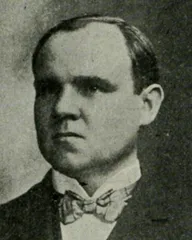
God's Foreknowledge Not a Determining
Cause
By James E. Talmage, of the Council of the Twelve
[Note: This article is one of the late numbers of a series of fifty-two,
which have been published in many of the great and influential newspapers
of the country during 1917. In some of the papers the articles ran through
the entire year, and in others they are still in course of publication. Among
the journals through which the teachings of the Gospel have thus been
spread broadcast are Boston Herald, New York World, Philadelphia Record,
Kansas City Journal, St. Louis Globe-Democrat, Atlanta Constitution, Wash-
ington Herald, New Haven Times-Leader, Hannibal Morning Journal,
Joplin News Herald, Portland Oregonian, San Francisco Chronicle. Dr.
Talmage's articles will continue to appear in all the foregoing papers in
1918, and with the beginning of the new year the New York Evening Tele-
gram, Florida Times Union, Chattanooga Times, and other jour-
nals have been added to the list. A second series of articles was begun
with 1918; which series it is hoped will continue throughout the year.
Copies of these articles printed weekly aggregate over a million and a half.]
Prophecy is one of the specified gifts of the Spirit, and one
of the distinguishing graces of the Church of Christ. If there
be prophecy there must be prophets, men through whom the
purposes of God are made known to the people at large. Pre-
diction of events more or less remotely future is a prophetic
function, though constituting but part of the gift of prophecy.
Divine revelation of what is to come is proof of foreknowl-
edge. God, therefore, knows, and has known from the begin-
ning, what shall be, even to the end of the world. The trans-
gression of Adam was foreknown, even before the man was em-
bodied in flesh ; and because of the results entailed upon human-
kind a Redeemer was chosen, even "the Lamb slain from the
foundation of the world." The earthly life, ministry, and sacri-
ficial death of the Savior were all foreseen, and their certainty
was declared by the mouths of holy prophets.
The apostasy of the Primitive Church, the long centuries of
spiritual darkness, the restoration of the Gospel in these latter
days in a land specifically prepared as the abode of a liberty-
loving nation — each of these epoch-marking events was known
to God, and by Him was revealed through prophets empowered
to speak in His name.
But who will venture to affirm that foreknowledge is a de-
termining cause? God's omniscience concerning Adam cannot
reasonably be considered the cause of the Fall. Adam was free
GOD'S FOREKNOWLEDGE NOT A DETERMINING CAUSE 405
to do as he chose to do. God did not force him to disobey the
Divine command. Neither did God's knowledge compel false
Judas to betray the Christ, nor the recreatn Jews to crucify their
Lord.
Surely the omniscience of God does not operate to make of
men automatons, nor does it warrant the superstition of fatalism.
The chief purpose of earth life, as a stage in the course of the
soul's progression, would be nullified if man's agency was after
all but a pretense, and he a creature of circumstance compelled
to do as he does.
A mortal father who knows the weaknesses and frailties of
his son may by reason of that knowledge sorrowfully predict the
calamities and suffering awaiting his wayward boy. He may
foresee in that son's future a forfeiture of blessings that could be
won, loss of position, self-respect, reputation, character, and
honor. Even the dark shadows of a felon's cell and the night
of a drunkard's grave may loom in the visions of that fond
father's soul. Yet, convinced by experience of the son's deter-
mination to follow the path of sin, he foresees the dread develop-
ments of the future, and writhes in anguish because of his
knowledge.
Can it be truthfully said that the father's foreknowledge is
even a contributory cause of the evil life of his boy? To so hold is
to say that a neglectful parent, who will not trouble himself to
study the character of his son, who shuts his eyes to sinful ways,
and rests in careless indifference as to the probable future, will
by his very heartlessness benefit the boy, because the father's
lack of forethought diminishes the son's tendency toward dere-
liction.
By way of further illustration, consider the man versed in
meteorology, who by due consideration of temperature, air-
pressure, humidity, and other essential data, is able to forecast
weather conditions. He speaks with the assurance of long ex-
perience in foretelling a storm. The storm comes, bringing bene-
fit or injury, contributing to the harvest perhaps or destroying
the ripening grain; but, whether it be of good or ill effect, can
he who prophesied of the approaching storm be held account-
able for its coming?
It may be argued, however, that in these illustrative in-
stances neither the mortal parent nor the human forecaster had
power to alter the respective course of events, while God can
direct and over-rule as He wills. But, be it remembered that
God has granted agency unto His children, and does not control
them in its exercise by arbitrary force. He impels no man
toward sin; He compels none to righteousness.
The Father of our spirits has a full knowledge of the nature
406 IMPROVEMENT ERA
and disposition of each of His children, a knowledge gained by
observation and experience in the long ages of our primeval
childhood, when we existed as unembodied spirits, endowed with
individuality and agency — a knowledge compared with which
that gained by earthly parents through experience with their
children in the flesh is innnitesimally small. In that surpassing
knowlege God reads the future of child and children, of men
individually and of men collectively. He knows what each will
do under given conditions, and sees the end from the beginning.
His foreknowledge is based on intelligence and reason. He fore-
sees the future of men and nations as a state that naturally and
surely will be; not as a state of things that must be because He
has arbitrarily willed that it shall be.
"Known unto God are all his works from the beginning of
the world" (Acts 15:18).
He willed and decreed the mortal state for His spirit off-
spring, and prepared the earth for their schooling. He provided
all the facilities necessary to their training, and thus proclaimed
His purpose:
"For behold, this is my work and my glory — to bring to pass
the immortality and eternal life of man" (Pearl of Great Price,
Moses 1:39).