Jesus Christ: The Revelation of God
Improvement Era, vol. 5, no. 12, October 1902, pp. 969 to 979
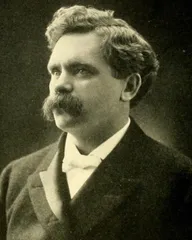
BISHOP EDWARD HUNTER. 967
stuff was very scarce; we dug segos and other roots for food. The ground, when irrigated, produced well. " Our brethren of the Mormon Battalion arrived in Salt Lake
Valley with plenty of gold, but they had no flour, which was worth fifty cents a pound, and could not be bought at any price, as it was
not to be had. " We saw some very close times, being so far away from civ- ilization, and having the crickets and grasshoppers to fight, to
prevent their eating up the little we expected to live on; and there was an influx of gold diggers, who came from the East, on their way to the gold fields of California. We still had hope, and put our trust in God, as we had left all behind us for the gospel's sake. We felt thankful for our deliverance, being free from persecutions and mobs. Away from our enemies, surrounded by the strength of the hills, we commenced hauling wood from the everlasting canyons, and making improvements and cultivating the soil. " In the fall of 1849, I was called by President Young, with
the first company of missionaries that left the Rocky Mountains, to go back to the Missouri River and bring a company of Saints to the Salt Lake Valley. I left October 19, and took with me about $5000 in gold dust— the first gold deposited in the Philadelphia mints from California. When ready to return, I found it very difficult in getting a fit-out. Oxen, wagons, and horses had been bought up, on account of the gold excitement in California. I
oxen and green teamsters to con- finally got fitted out, having wild ready to make tend with. On the fourth of July, 1850, we were a start for the west. " I had a few good men with me who took an interest, and
their labors I shall ever remember. While on our journey the that their rights Indians became somewhat hostile, they feeling the country. were infringed upon, seeing so many traveling over warriors came Unexpectedly, about five hundred young Indian ready for defense. upon us. We were in camp, and made ourselves but their chiefs The young braves were very anxious to fight, impossible to hold them wanted to counsel with us. It was almost while we stood ready with our guns at a moment's notice, back, and the chiefs and braves were ready on their horses. A half- was standing breed,who came along with us as a teamster, and
by my side, raised his gun as if to kill one of the chiefs. As soon as the Indian chief saw his gun raised, he dropped on the opposite side of his horse, as if to escape death.As soon as this happened one of my men raised his gun and pointed it at the half-breed and
said, You will be the first one to die.' As soon as the young '
braves witnessed this, they changed their minds, and, with their chiefs, we smoked the pipe of peace, gave them flour, sugar and provisions; and they left us, feeling satisfied. This was a very close call, as they had come upon us with the full determination to fight. We had no further trouble with the Indians, and arrived in Salt Lake Valley on the tenth day of October, 1850. "My accounts were audited; cattle and outfit were some $700 better than when we started; our stock were in good shape. President Young was well pleased, and remarked, This is the way '
we will continue to bring our poor brethren to the Rocky Moun- tains.'
"February 14, 1849, 1 was appointed bishop of the Thirteenth ward of Salt Lake City. April 7, 1851, was appointed successor to Newel K. Whitney as Presiding Bishop; was set apart by Heber C. Kimball and Willard Richards, the latter being mouth. At the same conference, April 6, 1851, I was appointed assistant Trustee- in-trust of the Church. I assisted in laying the north-west corner- stone of the Salt Lake Temple, April 6, 1853. I presided over the fir.t bishop's meeting ever held in Salt Lake City, of which there is any record. It was in the Council House, June 24, 1851." The last bishop's meeting which Bishop Hunter attended was in the Social Hall, Thursday evaning, September 13, 1883. He held the office of Presiding Bishop for over thirty-one years. He died in Salt Lake City, October 16, 1883, beloved by all the Saints.*
*A character sketch of Bishop Hunter, by Elder John Nicholson will appear in volume six of the Improvement Era, and also a collection of some of his noteworthy sayings.
JESUS CHRIST: THE REVELATION OF GOD/
BY B. H. ROBERTS.
III.
THE CHARACTER GOD REVEALED IN THE LIFE OF JESUS CHRIST.
Having proved from the scriptures that Jesus Christ is God, and the revelation of God to man, I come to another branch of my subject. I now wish to show you that Jesus Christ manifested
God also in his life and although I have been addressing you for ;
some time, I am quite sure you yourselves would not be entirely satisfied with the treatise upon this subject, unless I pointed out how God would act under the variety of circumstances in which it is our privilege to behold him acting. First of all, I call your attention to the deep, the profound humility of God ; his great condescension in living among men, as he did, for our instruction; and from that circumstanca would draw to your attention the lesson of humility his life teaches. The heights of glory to which Jesus had attained, the power and dignity of his position in the heavenly kingdom, of course, cannot be comprehended by us in our present finite condition, and with our limited knowledge of things. Great and exalted as we might think him to be, you may depend upon it he was exalted infinitely higher than that. Then when you think of one living and moving in the courts of heaven and mingling in the councils of the Gods,
*A discourse delivered in the Tabernacle, Ogden, Utah, Tuesday evening, April 22, 1902, under the auspices of the Young Men's Mutual Improvement Association of the Weber Stake of Zion.
consenting to come down to this earth and pass through the con- ditions that he passed through, do you not marvel at his humility? To be born under such circumstances as would enable wicked men to cast reflection upon his very birth!* To be born, toa, in a stable, and to be cradled in a manger To grow up a peasant, with a peas- !
ant's labor to perform, and a peasant's fare to subsist upon from childhood to manhood —do you not marvel at this great humility, God? And by his humility, are not at this great condescension of men taught humility, as they are taught it by no other circum- stance whatsoever! Of his youth, we know but but the little we know re- little ;
veals a shining quality, either for God or man to possess. You must remember, in all our consideration of the life of Messiah, one truth, which comes to us from the scriptures in an incidental way, viz., that " In his humiliation his judgment was taken from him."t As the veil is drawn over our minds when our pre-existent spirits come into this world, and we forget the Father and Mother of the spirit world, and the positions we occupied there, so, too, with Jesus ; in his humiliation his judgment was taken from him ; he knew not at first whence he came, nor the dignity of his station in heaven. It was only by degrees that he felt the Spirit working within him and gradually unfolding the sublime idea that he was peculiarly and pre-eminently the Son of God in very deed. When at Jerusalem, about twelve years of age, he began to be conscious of the suggestions of the Spirit within him, and hence let the caravan with which he had come from distant Galilee to Judea return without him, much to the perplexity and sorrow of his par- ents. They, missing him, returned and found him in the temple disputing with the doctors and lawyers. They reprimanded him, as they would reprimand any boy guilty of similar conduct; but when they reproved him, he answered, " Wist ye not that I must be about my father's business." He began to understand his mis- sion. The spirit promptings were at work in his soul. And while ultimately the spirit was given without measure unto him,$ it was
*St. John viii: 41.
t Acts viii: 33. % St. John iii : 34.
JESUS CHRIST: THE REVELATION OF GOD. 971
not so at first, for " He received not of the fullness at the first, but- received grace for grace."* The child Jesus " grew, and waxed strong in spirit, filled with wisdom: and the grace of God was upon him And Jesus increased in wisdom and stature, and in favor with God and man."f But notwithstanding Jesus, at twelve vears of age, and earlier, began to experience the opera- tions of the Spirit calling his soul to his mission, still we are told that he returned with his parents to Galilee, " and was subject unto them." He who had given the law, "Honor thy father and thy mother," in this act exemplified the honor that he entertained for that law, in his practice of it. We n?xt see him coming to the banks of Jordan, where a prophet of God is baptizing — one of those strange, eccentric men, who lived for the most part in the wilderness, whose food was locusts and wild honey, and whose clothing was the skins of wild animals ; and yet through all this eccentricity, through all this oddness of character, shone the divine powers of God in this mes- senger, and multitudes of people gathered to his preaching by the Jordan, where he baptized them for the remission of their sins* By and by, Jesus comes and demands baptism at this man's hands ;
and as he enters the water, the prophet stays him, and says, " I have need to be baptized of thee, and comest thou to me ?
" expression of God,"— Already, doubtless, shining through this this Jesus of Nazareth,— the servant of the Lord, in attune, through the spirit of inspiration, with the very God who was approaching him, felt the divinity of his presence, and would fain Suffer " acknowledge his own inferiority. What was the reply ? it to be so now for thus it : becometh us to fulfil all righteousness."
He who had said that men must be baptized for the remission of sins, though himself sinless, would honor that law by obedience unto it. Thus we learn that God can not only give law, but he can quali- obey law. Indeed, only those who know how to obey law are fied to make it. Christ, Next we shall see how God, in the person of Jesus he was manages himself under temptation. After his baptism,
- Doc. and Cov., Sec. xciii: 12, 13.
f Luke ii: 40, 52.
driven of the spirit into the wilderness, where he fasted forty days and forty nights. There under the quiet stars, and in the desert* he was consecrating his life to the service of God the Father, and gathering to himself those spiritual forces, and calling up those divine powers, that should carry him through the three years of storm and tempest that must be his in the fulfilment of his mission. When he had reached his greatest point of weakness, when "an hungered," and fainting from his long fast, whom do you suppose came into his presence to tempt him? No other than his arch- enemy; the one with whom he contended in the councils of God before the foundations of this earth were laid, when the great plan of life and salvation was being discussed —Lucifer, in the full pride of his strength and glory came tempting him. I say Lucifer came in the fullness of his strength and glory; for I take it that at this time he had well-nigh reached the pinnacle of his power. We have seen that he had blinded all the races of men respecting God. Truly, he held the nations of the world and their glory within his own hands ; and the knowledge of the true God was not had among men. Proudly, therefore, he steps to the side of the weakened God, to propound certain questions to him. In substance, he said, "You have had whisperings of the Spirit that you are Deity, that you are the Son of God. If so, exercise your creative power, turn
these stones into bread, and satisfy your hunger. Come, since you are a God, you must needs have creative powers; try it upon these stones and hunger no more." God, in the presence of his arch- enemy, still retained his humility, and said, "It is written, Man shall not live by bread alone." After that, Lucifer takes the Christ to the pinnacle of the temple, and tries him upon another side — a side upon which good men are particularly vulnerable, the side of their vanity, that prompts them to believe they are the special favorites of heaven, and that God had given his angels charge concerning them. ' Christ's tempter said, If thou be the Son of God, cast thyself '
down: for it is written, he shall give his angels charge concerning thee : and in their hands they shall bear thee up, lest at any time thou dash thy foot against a stone." Again the Son of God an- swers in humility, " It is written also, Thou shalt not tempt the Lord thy God." Because God has given you certain promises, you
JESUS CHRIST: IRE REVELATION OF GOD. 973
apostles, and prophets, and men of God; because you, by your righteousness, perchance have made yourselves of the elect, it is
not becoming that you should be putting God constantly upon trial."Thou shalt not tempt the Lord thy God." Walk your pathway in the light of common sense, and be not puffed up with vanity because there is something special in your relationship with God. Lucifer next approaches Jesus upon the side most vulnerable of all, in quick and mighty spirits — on the side of ambition. I
take it that there have been but few strong men who have not felt the desire to rule, to govern ; and not always selfis ly either, or for personal ends, but sometimes out of an honest thought that they can do somewhat of good for humanity. Even good men may love power, and may aspire to the righteous exercise of it.It was
upon this side that Lucifer sought to break in upon the virtue of Jesus. He unveils the kingdoms of the world, which he holds in his thraldom; he reveals their glory, and the might and majesty to which men may attain, if only they can grasp the sceptre of some great empire. Now, says he, "All these things will I give thee, if thou wilt fall down and worship me." He who has an- swered in tones so humble up to this point, and has endured the taunts and questionings of his great enemy with becoming modesty and humility, now, evidently, feels stirring within him some of those master powers that m ly shake the woild and send the stars out of their courses, "Get thee hence, Satan," said he, " for it is written, Thou shalt worship the Lord thy God, and him only shalt thou serve." The Spirit of the Son of God was aroused, and it was time for Lucifer's departure, and so he left Jesus, and angels came and ministered unto him. So God deports himself under trial and temptation. How splendid the lesson for man !
JefUS was possessed of infinite compassion. The incidents are in quota- that I shall relate to you, in support of this statement, spirit of the tions that are free, and yet, I think, justified by the After all, it is the spirit that giveth life; the letter occasion. killeth; so let us look at these things in the spirit of them. You approaching the little see him one day with some of his disciples Nain, "His raiment dusty and his sandals worn." As village of they draw near, the gate is opened and a funeral procession
marches out. The mother of the young man whose body is being borne by his neighbors to the final resting place, walks feebly and weeping beside the bier, desolate in her loneliness. As Jesus saw that poor woman, in the midst of her sorrow, his heart — pray you I
think of it, for we are speaking of God when we speak of Jesus Christ, the Creator of heaven and earth —the heart of God, is
moved with compassion towards this woman. He stops the bier, takes the dead by the hand, and says, " Young man, I say unto thee, Arise." And he arose. Jesus Christ gave this woman back her son. It was an act of beautiful compassion, one of many, which illustrates how tender and sympathetic is the heart of our God! Nor was his ministry confined exclusively to the poor, to the widows, to the lonely. He despised not rulers, nor the rich; be-
cause they were such; but was willing, if only they could put themselves in a position to receive the manifestations of his com- passion — he was willing to minister unto them. This is proved in the case of Jairus, one of the rulers of the Jews, and a man of great wealth. You will remember that he came running to the Master with his sorrow — his daughter was lying dangerously ill at home; and such was his faith that if the Master would but speak the word, she would be healed. While he yet spake, one of his servants came running, saying, "Thy daughter is dead: trouble not the Master." But Jesus heeded not the word of the servant. He had heard Jairus' cry of faith, and, responsive to that faith-cry, he made his way to the home of the ruler, put out those who might be unbelieving, and, taking the maid by the hand, gave her back to the gladness of life, into the arms of the joyous father. The faith of that rich man was as great as the faith of any ve meet with in all the ministry of the Lord. So, wealth is not a hindrance to faith. God is as close to the rich as to the poor, and as ready to grant them his mercy, according to their faith and I ;
sometimes think we make a mistake when we would flout those who are rich, and put them outside the pale of God's mercy and goodness because they are rich. While on the way to the ruler's house, another incident hap- pened that is very remarkable. A woman in the throng, a long time afflicted with a grievous ailment, said in her heart as she saw
JESUS CHRIS1: THE REVELATION OF GOD. 975
him pass, " If I may but touch his garment, I shall be whole." Accordingly, she crowded her way forward, dropped upon her knee, clutched the garment, and received the divine power f rom'him which cleansed her body and healed her completely. Jesus, observing that something had happened to him, turned to the apostles and said, " Who touched me ? " They replied, " Master, the multitude
throng thee and press thee, and sayest thou, Who touched me ? " as that was not to be expected in such a crowd. if Ah! said Jesus, but " I perceive that virtue is gone out of me." What was it? Simply that through this poor woman's faith —who supposed herself so far removed from God that she dare not come into his presence and ask for the blessing she desired, but undertook to obtain it by indirect means —through her faith and touching the garment of the Lord, the healing virtues passed from God to her in such a tangible manner that he felt their departure, just as some of you elders, when administering to one who was full of faith, have felt your spiritual strength and life go out from you, leaving you weak and almost helpless, but giving healthful life to the afflicted. I speak to men who have experience in these things,
and I know that scores of you could bear witness to the truth of this phenomenon. If our lives can but touch the life of God,
such is his nature that we shall partake of th9 virtues that go out from him. What shall I say of lepers who crowded upo.i his presence, and who, notwithstanding the loathsomeness of that disease, found sympathy and help from contact with him. Wh it of the blind, the lame, the halt? Why, let us not speak of them for though it is ;
a great thing that their bodies should be healed, and they should go through the community singing the praises of him who had re- stored them, there are better things to speak of— the healing of men's souls, the purifying of their spirits. Let us ask rather, how did Jesus Christ deal with sinners? I take one incident that has always appealed very strongly to me, and it illustrates the spirit in which Christ deals with sinners for ;
this God of ours is peculiarly the friend of sinners. The over- righteous Pharisees of Christ's time would not for the world come should be polluted. in contact with sinful men, lest they themselves sanctity about them, and con- They gathered the robes of their
sidered themselves in such close relation with God that they could afford to despise his poor, unfortunate, sinful children, instead of holding out the hand that would bring them from the kingdom of darkness into the brightness and glory of the kingdom of God. But not so with Jesus Christ. When he was accused by this class of men of mingling with publicans and sinners, his answer to them was, " They that are whole need not a physician ; but they that are sick. I came not to call the righteous, but sinners to repent-
ance." As if he had said, you who are righteous and have no need of healing for sin, stand by yourselves ; my mission is not to you, but to those who have need of God's help. Such was the spirit of his answer. The incident to which I refer as illustrative of his compassion for sinners, is this: The Jews were always on the alert to entrap the Messiah's feet and bring him into contradiction with the law of Moses. The law of Moses, as first given to Israel, was that if any should be found in adultery they should be stoned to death; but the Rabbis, by nice discriminations of words, prac- tically had rendered that law a dead letter, by reason of which the adulterers in Israel escaped the punishment that God had decreed against them. Therefore, they thought if they could take a per- son who unquestionably had been guilty of this crime and bring him or her into the presence of Jesus, they would either bring him in conflict with the law of Moses, or with the tradition of the elders, and in either case would have sufficient cause to denounce him before the people. So they found a woman, caught in the act; they dragged her through the streets, and cast her at his feet. "Master," said they, " this woman was taken in adultery in the very act. Now Moses in the law commanded us, that such should be stoned but what sayest thou ? " He replied, " He that :
is without sin among you, let him first cast a stone at her." One by one they slunk away, until the woman was left alone with Jesus When Jesus looked around, and saw none but the woman, he said to her, " Woman, where are thine accusers ? hath no man condemned thee ? " " No man, Lord," she said. Then Jesus said " Neither :
do I condemn thee: go, and sin no more." That is how God deals with sinners. It is written that God cannot look upon sin with the least degree of allowance, and that is true, he cannot; but how about the sinner ? Why, he may look upon the sinner with
JESUS CHRIST: THE REVELATION OF GOD. 977
infinite compassion. While the sin must always be hateful, yet will he help and love the sinner, if he will but go his way and sin no more. Such is our human weakness, and so nearly the level upon which we all move, that there is none of us but will plead mightily for mercy; and, thank God, we shall not plead in vain;
for, while our judge cannot look upon sin with any degree of allow-
ance, his heart goes out in compassion and love to men, and he will help them to overcome sin, to fight a good fight, to keep the faith, and at the last enable them to win the crown in the kingdom of our God. Jesus, moreover, was tolerant. You will recall the circum- stance of his having to go through Samaria, and you remember that the Samaritans hated the Jews, and Jesus was a Jew. Some of his disciples went into a village of Samaria, through which Jesus would have to pass, and sought to make arrangements for the Master to stay over night; but the Samaritans closed their doors against him. They had heard of him; he was a Jew; and in the narrowness of their minds they would not admit the hated Jew into their homes. This very much angered the disciple John, who loved Jesus dearly. He was one of the "sons of thunder," and possessed of a spirit that could love; and being strong in love, as is often the case — I was going to say as is always the case he — was likewise strong in hating. He was the type of man that does both heartily. Hence, ha went to the Master and asked him if he might not call down fire from heaven upon those Samaritans for thus rejecting the Master. Jesus replied: "Ye know not what spirit you are of. The Son of Man came to save, not to destroy." A broadness, a liberality truly glorious. On another occasion some of the disciples found one casting
out devils in the name of Jesus, and they forbade him, because he followed not the Master. When they came into the presence of Jesus, they reported this case and told what they had done. Jesus
said, "Forbid him not: for there is no man which shall do a mir-
of me." Then he gave acle in my name, that can lightly speak evil truth, "He that is not for me is against us the other half of that for us." Thus me," by saying, "For he that is not against us is he 'corrected the narrow-mindedness of his own apostles. But tolerance, his patience and gen- notwithstanding all his mercy, his