Editor’s Table: Sympathy with Criminals; Modern Revelation
Improvement Era, vol. 5, no. 10, August 1902, pp. 803 to 807
EDITOR^S TABLE.
SYMPATHY WITH CRIMINALS.
There is a deplorable tendency among the people of this nation to sympathize with murderers, bank defaulters, evil adven- turers, and a hundred other classes of criminals who are at large or who have been arrested or convicted of breaking the law. Such' a tendency is not alone manifest in the various states and territories of our nation, it is also apparent among the Latter-day Saints. This sympathy for criminals is entirely ab- normal, and has a tendency to lower and destroy the moral sentiment of any people who indulges in it. For a Latter-day Saint to sympathize either with crime or with criminals, is a burning shame, and it is high time that the teachers of the community should stem such tendency and inculcate a sentiment that would make it extremely abhorrent to commit crime in our state. Recent examples in our country show to what extremes people willgo in sympathizing with outlaws who should be condemned by every right-thinking individual. Criminals should not look for sympathy from any one. It is only some weeks ago that a woman eloped with certain murderers setting the whole nation agog, and many there were who sympathized with her daring flight rather than with the murdered man and his kin. We have had instances recently in Utah in which condemned criminals have received undue sympathy from weak women and foolish men. Any person who sympathizes with a criminal be- cause he is a 'good fellow," lays himself liable to the suspicion that he himself is a criminal; and openly advertises the fact that if anything should occur to cause him to break the law, that he
804 IMPROVEMENT ERA.
would look for like sympathy from his friends under similar cir- cumstances. Newspapers give full room to criminal affairs, and occupy their valuable space to lay bare to the public every indecent detail of crime, because the public demands it, and the newspaper that would not do it would be considered behind the times; hence, we have the discomforting spectacle of having spread before the com- munity every morning and evening the horrible details of mur- der, adventure, robbery and other violations of law. The result is that unthinking people, in addition to becoming criminal un- wittingly in their own thoughts, make heroes out of criminals by expressing unnatural sympathy for them. It is highly proper to encourage a sentiment among Latter-day Saints and in our associations entirely contrary to this, that would sympathize absolutely with law and order, honesty and virtue, and every other good doctrine and deed, and that would condemn unsparingly every man or woman who is a criminal, or who in any way sympathizes with crime. I wish the time would come when our people would not crowd to the court rooms to hear the details of crime, and when it would be consid- ered low and vulgar to spend any time in reading of criminal incidents, and when, in every other way, people would exercise their influence to condemn, stamp out, and to make exceedingly unpopular, both crime and its publication. Young men may please God by thinking right, by acting right, by shunning, as they would destruction, not only every crime, but the spirit to either see or sympathize with the criminal, or to hear or read the detail of his damnable acts. It is an old saying,
that we are what we think; then, to be a good Latter-day Saint it is necessary to think pure thoughts, to imbibe pure ideas, and to let the mind dwell continually upon the noble things, and the good deeds, and the exalted thoughts of life, discarding all sympathy or The man or interest for crime and criminals, and all thought of evil. woman who will resort to the court room, who will visit prisoners with flowers, who will read and constantly discuss every detail of crime, should be condemned, frowned upon, and their actions should When a mur- be made detestable in the eyes of the pure in heart. derer is condemned, he should be detested, dropped, and forgot-
EDITOR'S TABLE. 805
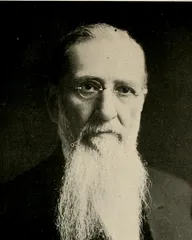
ten; and so also should criminals of other classes who sin grievously against law and the commandments of God. Joseph F. Smith.
MODERN REVELATION.
A certain minister of religion in Salt Lake City has recently announced as a doctrine that there is no good reason to believe that God will ever again reveal himself to man: first, because such revelations are not needed; second, they are inconsistent with the universal character of Christianity; third, there is no sufficient evidence that direct revelation has been given to man since the days of the Apostles; and, fourth, such modern revelations are useless, useless in our courts and in the courts of the church which believes in them. The ministers as an association have discussed the subject, and tried to prove that modern revelation is untrue, although they have not come to a unity on how that can be done; but they have resolved in substance that "so-called revelations which go to prove that Joseph Smith was a prophet are inept and inconclusive." In other words, 'we have no reason to believe," says the first one referred to, in a sermon, "that God has ever communicated his will to man as he did to Moses, Isaiah, and John." We are to understand, then, that God does not, and will not further make known his will to men; that what he has said suffices.
His will to Moses and Isaiah and John is abundant for modern followers of Christ. The Latter-day Saints take issue with this doctrine, and pronounce it illogical, inconsistent, and untrue, and lives and that he reveals bear testimony to all the world that God his will to men who believe in him and who obey his command- history of nations. ments, as much in our day as at any time in the The canon of scripture is not full. God has never revealed at any If we are per- time that he would cease to speak forever to men. mitted to believe that he has spoken, we must and do believe that
he continues to speak, because he is unchangeable. His will to Abraham did not suffice for Moses, neither did his
806 IMPROVEMENT ERA.
will to Moses suffice for Isaiah. Why? Because their different missions required different instructions; and, logically, that is also true of the prophets and people of today. A progressive world will naver discover all truth until its inhabitants become familiar with all the knowledge of the Perfect One. How shall men be- come acquainted with the knowledge of the Father? Only as he reveals it to them. Now if we are permitted to believe that the Lord revealed himself to the ancients of whose deeds we read in the Holy Scriptures, it seems to me that there is no good reason for believing that it is not necessary that he should reveal himself in this day to others who desire to be guided by his spirit and in- spiration. Every new truth which grows into living action in the lives of men, is a revelation in itself from God, and without the revelation of additional truth, men would not progress in this world, but, left to themselves, would retrograde, being cut off from the light and life of the great fountain of all intelligence, the Father of All. What is revelation but the uncovering of new truths, by him who is the fountain of all truth? To say that there is no need of new revelation, is equivalent to saying that we have no need of — new truths a ridiculous assertion. As well, too, might we say that the revelations which Abraham received were sufficient for the prophets; that the revelations given to Enoch were sufficient for Noah, whose mission was to build the ark and preach repent- ance; or that the words spoken to Moses were sufficient for all time; or that what Abraham received would be ample for his children through all the ages. But not so. Notwithstanding Abraham was favored with great promises, the word of God was not denied to his son Isaac, nor to his grandson Jacob. Why? Because these could not have performed their missions on the word of the Lord alone to their father and to others. And how could the Father of the Faithful have accomplished his work on the instructions received by Noah? Of what personal use were the revelations of prior patriarchs and prophets to Balaam or to Paul? It is true, they were of use as historical truths or lessons, but not sufficient for them individually. So we moderns stand in need, oh so greatly! of constant revelation, that we individually may fill our missions acceptably to our Father, and that we may
EDITOR'S TABLE. 807
the better work out our own salvation; and also that we may know the will of God concerning his Church, hispeople.and his purposes in regard to the nations. These are a few of the thousand needs that exist for revelation. The Salt Lake minister declares, too, that revelations "are inconsistent with the universal character of Christianity." If that be true, then it is because Christianity has itself become incon- sistent by departing from God, and by dividing against itself, so that so-called Christians can no more be counted as his people or his church, because of their apostasy, denial, and repudiation of him. If so-called Christianity were the true church of God, and not a host of warring sects, no reasonable man would consider it
inconsistent for the head of the church to receive revelation from God for the guidance of the church; nor would it be inconsistent for each member of the church to receive revelation for his indi- viiual benefit concerning things that pertain to him and to his and that would provide him with a knowledge that the affairs,
word of God, given through the head of the church, is true. One would not conflict with the other. There would be universal union, inspired by revelations from the Great Head of the Church, the Fountain of Truth, who once declared, "Unless ye are one, ye are not mine." Such conditions would need no contending salaried ministers; oneman would be as useful as another, to teach, testify and expound, since all would be inspired by the same spirit, and each would build the other up. No; revelation, general and personal, is not inconsistent with true Christianity; rather, it is much needed to unite true Christians into one grand union, with Christ at the head. that To the assertion that "there is no sufficient evidence the days of the direct revelation has been given to man since necessary to state that there is just as good Apostles," it isonly heavenly beings evidence that Joseph Smith received visits from as that Abraham, Moses, or Enoch saw God. Men have soberly visitation of angels: declared themselves as eye-witnesses to the revelations of Joseph the Prophet, and, besides, the fruits of the Church of Jesus Christ of Latter-day in the establishment of the Saints— the "marvelous work and a wonder"— are evidences the truth of what he de- enough in themselves to demonstrate