The Mormons and the United States Flag
Improvement Era, vol. 25, no. 1, November 1921, pp. 3 to 7
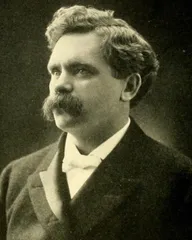
IMPROVEMENT ERA Vol. XXV NOVEMBER, 1921 No. 1 The "Mormons" and the United States Flag By B. H. Roberts, of the First Council of Seventy If respect and honor for the flag of one's country tends to establish loyalty to that country, then the "Mormons" have a strong claim to loyalty, by the evidence of such respect and honor for the flag. Even in the last months of their stay in the city of Nauvoo, and with every certainty that in the spring of 1846 they would be driven from their homes and expatriated from their country, the flag of the United States continued to wave from the tower of the Nauvoo temple. This flag belonged personally to President Brigham Young, and was brought by him to Utah. It is likely also that this was the flag under which the Mormon Battalion was mustered into service, at Council Bluffs, in July, 1846. Colonel Kane, who was present during the mustering in of the Battalion, says, "An American flag was brought out from the store-house of things rescued [i. e. from the debacle at Nauvoo] and hoisted to a tree mast — and in three days the force was reported, mustered, organized and ready to march." It may also have been this flag which, before the close of the year 1847, was raised within the fort erected on the pres- ent site of Salt Lake City, which event the late "Mormon" poetess, Eliza R. Snow, celebrated in her "Ode to the Flag." She arrived in Salt Lake City with one of the first companies fol- lowing the Pioneers, and entered Salt Lake Valley in September or October. "Soon after our arrival in the valley," she writes, "a tall liberty pole was erected, (planted in Mexican soil) and from its summit the Stars and Stripes seemed to float with even more significance, if possible, than they were wont to do on eastern breezes." Then in her Biography follows the
4 IMPROVEMENT ERA "Ode to the Flag," though doubtless the Ode was not written until some years later, probably 1865 : "I love that flag! When in my childish glee — A prattling girl, upon my grandsire's knee — I heard him tell strange tales, with valor rife, How that same flag was bought with blood and life. "And his tall form seemed taller when he said, 'Child, for that flag thy grandsire fought and bled! My young heart felt that every scar he wore, Caused him to prize that banner more and more. "I caught the fire, and as in years I grew, I loved the flag; I loved my country, too. # * # * # * * * * * "There came a time that I remember well — Beneath the Stars and Stripes we could not dwell! We had to flee; but in our hasty flight We grasped the flag with more than mortal might; "And vowed, although our foes should us bereave Of all things else, the flag we would not leave. We took the flag; and journeying to the West, We wore its motto graven on each breast." "Well do I know the spot," said William H. Hooper, Utah's delegate to Congress, "where the first liberty pole was raised, and from the top of which floated the Stars and Stripes, while yet the country was known as Mexican territory." (Speech against the Ashley Bill to dismember the territory of Utah, House of Representatives, Congressional Globe, February 25, 1869.) On the occasion of the first celebration of the anniversary of the entrance of the Pioneers into Salt Lake Valley, held July 24, 1849, we get another glimpse of President Young's flag and the authority for identifying it with the flag that waved from the tower of the Nauvoo temple, and probably the one under which the Mormon Battalion was mustered into the United States service. Under date of July 23, 1849, the Journal History of President Young (Ms.) tells of the preparation being made for the celebration of the entrance of the Pioneers into Salt Lake valley, in the course of which he says: "Captain Tyler and the artillerist were busy in the office making cartridges for the cannon. In the evening my flag that used to fly from the Nauvoo temple was hoisted at the east side of the bowery." From which circumstances we know that the United States flag was brought with the Pioneers from Nauvoo to Salt Lake City. In his History Journal for the next day, July 24, the President also says: "At half past seven (a. m.) a large national flag measuring sixty- five feet in length was unfurled at the top of the liberty pole, which is one hundred feet high, and was saluted with the firing
THE "MORMONS" AND THE UNITED STATES FLAG 5 of six guns, the ringing of the Nauvoo bell and spirit-stirring airs from the band. (History of President Young, Ms., dates July 23 and 24, 1849.) These circumstances connected with the de- parture of the Latter-day Saints from Nauvoo to Salt Lake val- ley, clearly establish their respect and loyalty to the flag of their country. For, from these early days until now, that flag has been honored in Utah. There has been one error promulgated in respect to the United States flag and "Mormon" history that I think, for the sake of accuracy in our history, ought to be corrected. This is the quite generally accepted idea or "understanding" that on the 26th day of July, when what is now called "Ensign Peak" was first visited by President Young and a group of Pioneers, they there and then raised a United States flag and named the mount "Ensign Peak." There is no evidence that they raised any flag on that mount at that time, or that they at all referred to the flag of the United States, when speaking of an "Ensign" in rela- tion to that "hill" in the side of the mountain. They were merely out exploring the Salt Lake valley northward, and extended their short journey as far as the Hot Springs, during which they climbed the hill we now call "Ensign Peak." Had such an event as raising the United States flag taken place at that time, it cer- tainly would have been recorded in the journal of some of the men present. Brigham Young gave the mountain its name, and makes an entry of that fact in his journal, but says nothing of any flag incident. Neither does Wilford Woodruff, who was given to recording details in his journal, and who relates the incident of naming "Ensign Peak" at length. The following is the complete entry upon the subject in Elder Woodruff's journal : "Monday, July 26, 1847. We went north of the camp about five miles, and we all went on to the top of a high peak in the edge of the mountain, which we considered a good place to raise an ensign. So we named it 'Ensign Peak,' or 'Hill.' I was the first person that ascended this hill, which we had thus named. Brother Young was very weary in climbing to the peak, he being feeble [had not yet recovered from effects of mountain fever.] We then descended to the flat, and started north to visit some hot sulphur springs." The "Ensign" that these Latter-day Saint Pioneers had in mind, and of which they had frequently spoken enroute, was something larger and greater than any national flag whatsoever; and what it was meant to represent was greater than any earthly kingdom's interest, and I speak not slightingly of earthly king- doms either; but this "Ensign," in the minds of the "Mormon" Pioneers concerned not one nation, but all nations ; not one epoch or age, but all epochs and all ages; not nationality, but humanity. It was to be the sign and ensign of the Empire of Christ, it was
6 IMPROVEMENT ERA a prophecy of the time to come when "the kingdoms of this world would become the kingdoms of our Lord and of his Christ; and when he shall reign forever and forever." (Revelations 11: 15.) On the occasion of calling the pioneers' camp together for reproof and instruction while yet on the Platte river, on the 29th day of May, President Young referred to this "Standard of Zion." Wilford Woodruff, after relating how the President addressed himself to the few non-members of the Church present in the camp, and how they would be protected in their rights — but they must not introduce wickedness into the camp, "for it would not be suffered" — said: "He then spoke of the 'Standard' or 'Ensign' that would be reared in Zion to govern the kingdom of God, and the nations of the earth, for every nation would bow the knee and every tongue confess that Jesus was the Christ; and this will be the Standard — 'The Kingdom of God and his Law.' * * * And on the Standard would be a flag of every nation under heaven, so there would be an invitation to all nations under heaven to come unto Zion." This was the significance of naming Ensign Peak, on that 26th day of July, 1847. It was the gathering of Israel out of all nations to the Standard of Zion that the Pioneers were thinking of, as is evidenced by many subsequent sermons in which the texts were: Revelation 11:15; also Daniel 2 and 7. "And it shall come to pass in the last days that the mountain of the Lord's house shall be established in the tops of the mountains, and all na- tions shall flow unto it. And many people shall go and say, Come ye, and let us go to the mountain of the Lord, to the house of the God of Jacob; and he will teach us of his ways, and we will walk in his paths; for out of Zion shall go forth the law, and the word of the Lord from Jerusalem." "And it shall come to pass in that day that the Lord shall set his hand the second time to recover the remnant of his people. * * * And he shall set up an Ensign for the nations, and shall assemble the outcasts of Israel, and gather together the dispersed of Judah from the four corners of the earth. "All ye inhabitants of the world, and dwellers on the earth, see ye, when he lifteth up an Ensign on the mountains; and when he bloweth a trumpet, hear ye." These and other texts from Isaiah were woven into a dis- course by Orson Pratt the Sunday following, viz., August 1, 1847. (Woodruffs Journal, entry August 1.) Later this "Zion Ensign" idea inspired Parley P. Pratt's muse in the following verses: ZION'S STANDARD Lo! the Gentile chain is broken; See, on younder distant mountain, Freedom's banner waves on high; Zion's standard wide unfurled, List, ye nations! by this token Far above Missouri's fountain, Know that your redemption's nigh. Lo ! it waves for all the world.
THE "MORMONS" AND THE UNITED STATES FLAG 7 Freedom, peace and full salvation Come, ye sons of doubt and wonder, Are the blessings guaranteed — Indian, Moslem, Greek or Jew; Liberty to every nation, All your shackles burst asunder; Every tongue, and every creed. Freedom's banner waves for you. Come, ye Christian sects, and pagan, Cease to butcher one another, Pope, and Protestant, and priest, Join the covenant of peace; Worshipers of God or Dagon, Be to all a friend, a brother; Come ye to fair freedom's feast. This will bring the world release. Lo! the King! the great Messiah, Prince of Peace, shall come to reign; Sound again, ye heavenly choir, Peace on earth, good will to men. This hymn to the Ensign or Standard of Zion was com- posed before July 24, 1849, for it was sung with great unction at the celebration of the second anniversary of the entrance of the Pioneers into Salt Lake valley. (See History of Brigham Young, Ms. entry for July 24, 1849. The Psychology of Repentance By Professor Enoch Jorgensen Repentance is the discontinuance of any conduct under the firm impression that it is displeasing in the sight of God. It embodies the following psychological steps: 1. The person recognizes wrong, feels his own inadequacy, begins to see what might have been. 2. He regrets his shortcomings and longs for the better life. 3. He resolves to eschew evil and reaches out for the good. 4. His resolution has its fulfilment in reformation, in discontinuance of former conduct. 5. The changed life makes him desirous to make restitu- tion so far as possible, to even up, for he begins to recognize the law of compensation. He repents. Truly he finds renewed life, salvation. Sandy, Utah